
Claude Opus 5.5 Launch: AA Leadership, Pricing, and Benchmark Analysis

Claude Opus 5.5 is available, and Artificial Analysis lists it first with an Intelligence Index score of 58. Higher capability and lower token prices make this a release worth examining. There is one essential distinction: the headline score uses maximum reasoning effort, while Anthropic’s estimated 40% task-cost reduction concerns typical work at default settings.
This launch-day analysis compares the announcement, API documentation, the complete official benchmark chart, and live Artificial Analysis pages. It is source-based reporting, not a claim that this blog has independently tested the model.
Release date, specifications, and availability
Anthropic dates the release September 22, 2026. The sources below were checked early on September 23 in Taiwan, UTC+8. These are API specifications; a subscription interface may expose different limits. Official model documentation
| Item | Confirmed detail |
|---|---|
| Claude API model ID | claude-opus-5-5 |
| Context window | 1 million tokens |
| Standard API maximum output | 128K tokens |
| Modalities | Text and image input; text output |
| Reasoning | Always-on adaptive thinking; medium effort by default |
| Claude plans | Pro, Max, Team, Enterprise |
| Developer platforms | Claude API, Amazon Bedrock, Claude Platform on AWS, Google Cloud, Microsoft Foundry |
Plan availability is documented on the Opus product page; cloud availability is listed in the API release notes. Access still depends on the platform and account configuration.
Artificial Analysis: first at max, with a different picture at medium
At the time checked, Artificial Analysis Intelligence Index v4.3.2 showed Opus 5.5 at 58, ahead of Fable 5.1 and GPT-6 Astra, both displayed at 53. These are the site’s rounded scores. Both Claude entries are labeled max with fallback; Astra is labeled max. Live AA leaderboard
AA has also published five Opus 5.5 effort variants. All rows below use Default Fallback. Token counts are aggregate output across the Intelligence Index evaluation, not a single response or the context-window capacity.
| Effort | AA Intelligence Index | Total evaluation output tokens |
|---|---|---|
| max | 58 | Approximately 260M |
| xhigh | 56 | Approximately 100M |
| high | 54 | Approximately 53M |
| medium | 51 | Approximately 38M |
| low | 42 | Approximately 20M |
My reading: test medium and high for routine development before making max the default. Using the displayed approximations, max produces about 6.8 times medium’s total output for seven more index points. That is not a bill multiplier: input, caching, and other charges also matter. It does show why the highest-scoring configuration and the most useful everyday configuration need separate evaluation.
AA’s new model pages still showed N/A for speed and cost per task, alongside some $0.00 price fields. Those fields conflict with Anthropic’s published paid pricing. This article therefore uses the official rate card and does not interpret the unfinished fields as free access or measured throughput. AA model page
All nine official benchmarks, including where Astra leads
The following reproduces the numerical comparison in Anthropic’s official chart, checked against its announcement. This vendor-published comparison is separate from AA’s overall Intelligence Index. “Not listed” means the chart provides no result, not that the model scored zero. Official announcement
| Benchmark | Opus 5.5 | Fable 5.1 | Opus 5 | GPT-6 Astra | GPT-5.6 Sol |
|---|---|---|---|---|---|
| Terminal-Bench 4.0 | 66.4% | 55.8% | 52.3% | 57.9% | 37.3% |
| FrontierCode v1.1 (Main) | 54.4% | 50.3% | 48.0% | 53.3% | 47.5% |
| CursorBench 4.0 | 57.8% | 51.8% | 46.6% | Not listed | 41.7% |
| GDPval-AA v2.1 | 1846 | 1735 | 1708 | 1542 | 1588 |
| AutomationBench | 40.0% | 31.4% | 26.9% | 41.4% | 28.8% |
| Humanity’s Last Exam, with tools | 67.7% | 65.6% | 63.6% | 57.2% | Not listed |
| Terminal-Bench-Science 0.1 | 58.7% | 52.6% | 29.0% | 64.6% | 22.4% |
| OSWorld 2.0, partial | 81.8% | 80.7% | 74.0% | Not listed | Not listed |
| Chartography, with tools | 89.0% | 88.4% | 83.4% | Not listed | Not listed |
GDPval-AA is a rating, not a percentage. The OSWorld partial label and tool-use conditions are retained because these rows do not all measure the same kind of success.
Terminal-Bench shows a 14.1 percentage-point gain over Opus 5 and an 8.5-point lead over Astra. The FrontierCode margin over Astra is only 1.1 points, however, and Astra has the highest listed scores on business workflows and agentic scientific research. The chart does not support a claim of universal superiority.
Its footnotes also matter:
- Most Opus 5.5 results use max effort, while Terminal-Bench uses xhigh; Astra’s Terminal-Bench result uses high. This is not an equal-effort experiment.
- Production safeguards are enabled, and some tasks fall back to older models. Zapier’s AutomationBench runs use no fallback, counting safeguard interventions as failures.
- Opus 5.5’s Terminal-Bench standard error is ±2.6 points. The science benchmark reports approximately ±3.5–5 points per model. Small margins should not be treated as settled rankings.
View the complete official benchmark image and footnotes
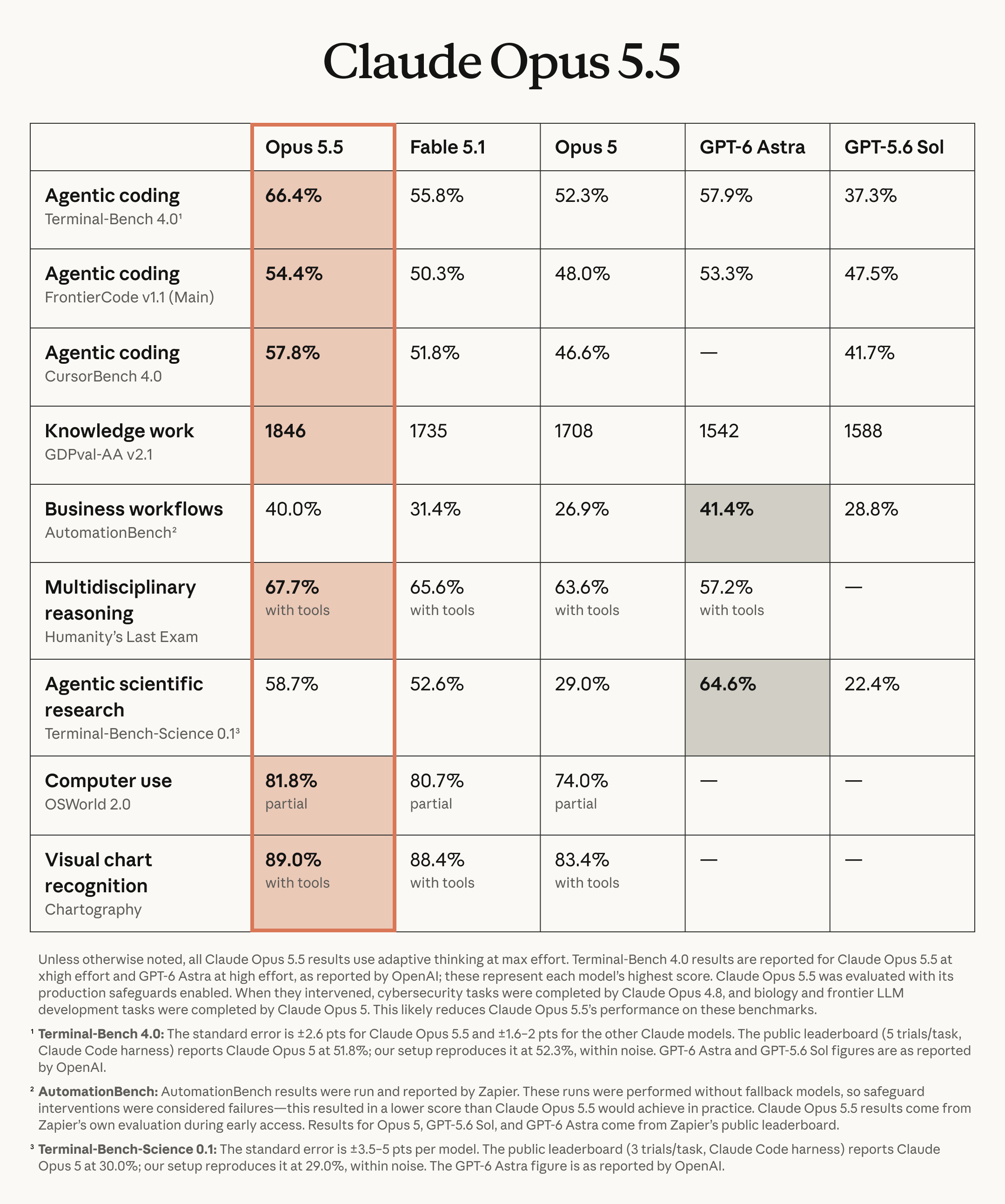
Image credit: Anthropic’s official release materials. Original figures and footnotes are preserved.
Pricing: distinguish the 20%, 40%, and 60% reductions
Standard Claude API prices are in USD per million tokens. Official pricing documentation
| Charge | Opus 5 | Opus 5.5 | Unit-price reduction |
|---|---|---|---|
| Uncached input | $5 | $4 | 20% |
| Output | $25 | $20 | 20% |
| Five-minute cache write | $6.25 | $5 | 20% |
| One-hour cache write | $10 | $8 | 20% |
| Cache-hit read | $0.50 | $0.20 | 60% |
The 40% figure is Anthropic’s estimated reduction in typical task cost, combining pricing and token efficiency. It is not a blanket 40% rate-card discount. Anthropic also reports over 30% faster output generation; that does not guarantee a project finishes 30% sooner. Announcement
Consider a fixed-volume example: one million uncached input tokens and 200,000 output tokens, excluding tools and other charges, cost $10 on Opus 5 and $8 on Opus 5.5. That saves 20%. Fewer retries, shorter outputs, or better cache use can reduce the bill further, but those are workload outcomes to measure.
Repeated repository reads are particularly relevant: ten million cache-hit tokens cost $2 instead of $5, excluding the original cache write and any output.
Fast mode has a separate premium rate of $8 input and $40 output, with Anthropic advertising up to 2.5 times standard speed. Opus 5.5’s standard input/output rates are also 60% below Fable 5.1’s $10/$50; that remains a token-price comparison, not a guarantee about total task cost. Opus product page, model comparison
Subscription limits and a reset you can save
Anthropic announced higher five-hour limits for Pro, Max, and Team, plus a subscription limit reset users can activate when needed. The announcement does not specify one universal increase, so “every plan doubles its allowance” would be unsupported. Official announcement
Eligible accounts can find Settings → Usage → Resets → Reset for free on the web or desktop app. The offer specifies whether it resets session or weekly usage and when it expires. Mobile and the Claude Code terminal currently lack that button, but the restored account allowance applies there too. Reset instructions
An API price cut is not a subscription-price announcement. For a broader purchasing comparison, see this blog’s AI coding subscription guide, keeping its snapshot date in mind.
Four API migration changes to check before switching traffic
Choosing a model in Claude and migrating a custom Messages API integration are different operations. For the latter, review more than the model ID:
- Thinking cannot be disabled. Old
thinking.typevalues"disabled"and"enabled"return 400; use effort instead. - Forced tool calls are unsupported. Replace
tool_choicetypesanyortoolas appropriate withautoand strict tools or structured outputs. Strict schemas do not guarantee a tool will be called. API release notes - Thinking blocks bind to their model and conversation. Editing earlier context can invalidate replayed blocks; check cross-model routing too.
- Computer use varies by platform. Claude API and Google Cloud require
computer_toolset_20260801; Bedrock still acceptscomputer_20251124. Migration guide
There is also a response-format change: narration between tool calls moves into thinking blocks, whose text is empty under the default display setting. A UI that streams only text blocks can consequently appear silent; update its parsing and display configuration. Response-format documentation
How I would evaluate the upgrade
If Opus 5 is already part of your coding workflow, Opus 5.5 deserves an early trial. Use a familiar task with a verifiable outcome, then record passing tests, human corrections, elapsed time, and total cost. AA’s effort table suggests useful configurations to compare; it cannot decide your acceptance criteria.
For scientific research or business automation, keep Astra in that comparison. For a move from Fable 5.1, establish that difficult tasks retain their quality before treating the lower unit price as a saving.
Also record which model actually finishes the task. With fallback describes part of the deployed behavior: Anthropic explains that some requests switch models and the interface identifies the responder. Model-switching documentation
This article reflects sources checked early September 23, 2026, UTC+8. Rankings and account benefits can change. Sonnet 5.5 and Haiku 5.5 are announced for the coming weeks, not simultaneous releases. Launch announcement


