
How to Buy AI Subscriptions Without Overpaying: Same $20, 26x Difference

Here is something most people never find out: among AI subscriptions that cost roughly $20 a month, one gives you about 26 times the official-API-equivalent usage, another gives you 1x. Same price, more than a twentyfold gap in what you actually get, and the official pricing pages only say things like “generous”, “expanded” or “boosted” without a single number.
So the answer to “which AI subscription is the best deal” was never “the most famous one” or “the most expensive one”. It starts with understanding how much AI each dollar actually buys. This post uses September 2026 data to break that down into three parts, multiplier, model capability and budget, and ends with a ranking site I built that updates itself every day so you don’t have to do the math.
Value is not the monthly fee, it’s the multiplier
The most common mistake is comparing monthly fees directly. $20 looks the same as $20, but the quota behind each can be worlds apart.
A fairer approach is to put every plan on the same scale: if the money you pay went straight to official API pricing, how much usage would it buy? Divide that API-equivalent usage by the fee and you get the “API-equivalent multiplier”. A 10x multiplier means each $1 you pay buys roughly $10 of official API usage; 1x means no discount at all, you might as well pay per token.
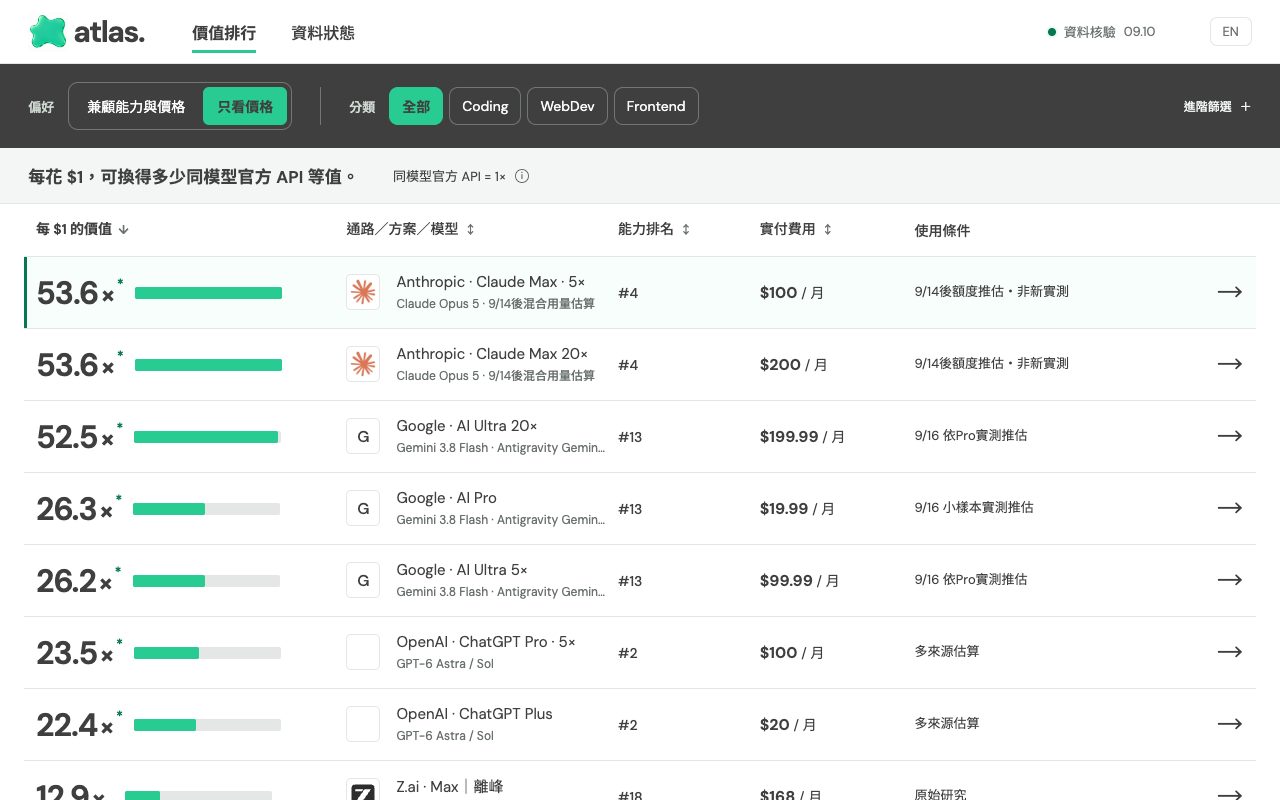
Measured this way, a lot of intuitions fall apart. Using data from September 17, 2026, in the $20 price band:
- Google AI Pro ($19.99): Gemini 3.8 Flash usage inside Antigravity estimated at about 26.3x
- ChatGPT Plus ($20): GPT-6 Astra / Sol multi-source estimate around 22.4x
- Z.ai Coding Lite ($18): GLM-5.3 at roughly 8.6x off-peak, about 4.3x at peak
- Cursor Pro ($20): about 1.0x regardless of which model you pick
Cursor’s 1x doesn’t mean it’s bad. What it sells is editor integration and the agent experience, not cheap tokens. But if you bought it hoping for discounted Claude or GPT, you bought the wrong thing.
Multiplier alone can mislead: cheap models aren’t always enough
Many high-multiplier plans bundle cheaper open-weight or second-tier models. DeepSeek V4.1 Flash and GLM-5.3 are already inexpensive on their official APIs, so when a reseller wraps them into a subscription the multiplier naturally looks great.
The real question is: is 10x of DeepSeek usage worth more to you than 5x of Claude Opus? It depends on the job. For quick scripts, document cleanup and everyday chat, a cheap model is plenty. For an autonomous refactor or a long-running agent task, one tier of model capability can cost you more in back-and-forth fixes than the subscription saved.
That’s why I add a second dimension when computing “value”: the model’s capability percentile on a same-domain leaderboard. Blending multiplier and capability with a geometric weighting yields a 0 to 100 recommendation score. Cheap-but-weak models don’t automatically win, and strong-but-slightly-pricier ones don’t get buried. If you want to understand how those leaderboards work, see my earlier post on reading AI model leaderboards.
September 2026 snapshot: the best deals right now
Below are the top entries in “balanced capability and price” mode as of September 17, 2026, plus a few popular reference points. Entries marked * are multi-source estimates rather than official-document conversions. These numbers move, so check the live ranking for the current state.
| Plan | Main model | Price | API-equivalent multiplier | Capability rank | Score |
|---|---|---|---|---|---|
| Command Code Go | DeepSeek V4.1 Flash | $1/mo | 10.0x | #12 | 80.5 |
| Claude Max 5x | Claude Opus 5 | $100/mo | 53.6x* | #4 | 79.8 |
| Claude Max 20x | Claude Opus 5 | $200/mo | 53.6x* | #4 | 79.8 |
| OpenCode Go | DeepSeek V4.1 Flash | $10/mo | 6.0x | #12 | 78.7 |
| Command Code GOAT | DeepSeek V4.1 Flash | $10/mo | 6.0x | #12 | 78.7 |
| R4 Coder Code Pro | DeepSeek V4.1 Flash (off-peak) | $20 one-time | 6.0x | #12 | 78.7 |
| Google AI Ultra 20x | Gemini 3.8 Flash | $199.99/mo | 52.5x* | #13 | 77.5 |
| Google AI Pro | Gemini 3.8 Flash | $19.99/mo | 26.3x* | #13 | 75.7 |
A few things worth noticing:
One dollar a month takes first place. Command Code Go is $1 for $10 of monthly credit shared across all its models, with no API access. It ranks first not because the model is the strongest, but because the price is low enough for the multiplier to make up the capability gap. Good for anyone on a tiny budget who just wants a usable coding agent.
Claude Max is the only top-five-capability plan with a high multiplier. The 53.6x figure is an estimate after Claude’s September 14 quota change, not a fresh measurement, hence the asterisk. If your workload can genuinely consume $100 of quota, it’s still the best way to buy a frontier model.
Claude Pro is off the board for now. There isn’t enough reliable usage data since the September 14 adjustment, so the ranking marks it “no reliable usage yet” instead of padding it with old numbers. This is exactly why static comparison posts go stale: my AI coding subscription comparison went up three days ago and the Claude Pro figure in it already can’t be used as-is.
How to buy by budget
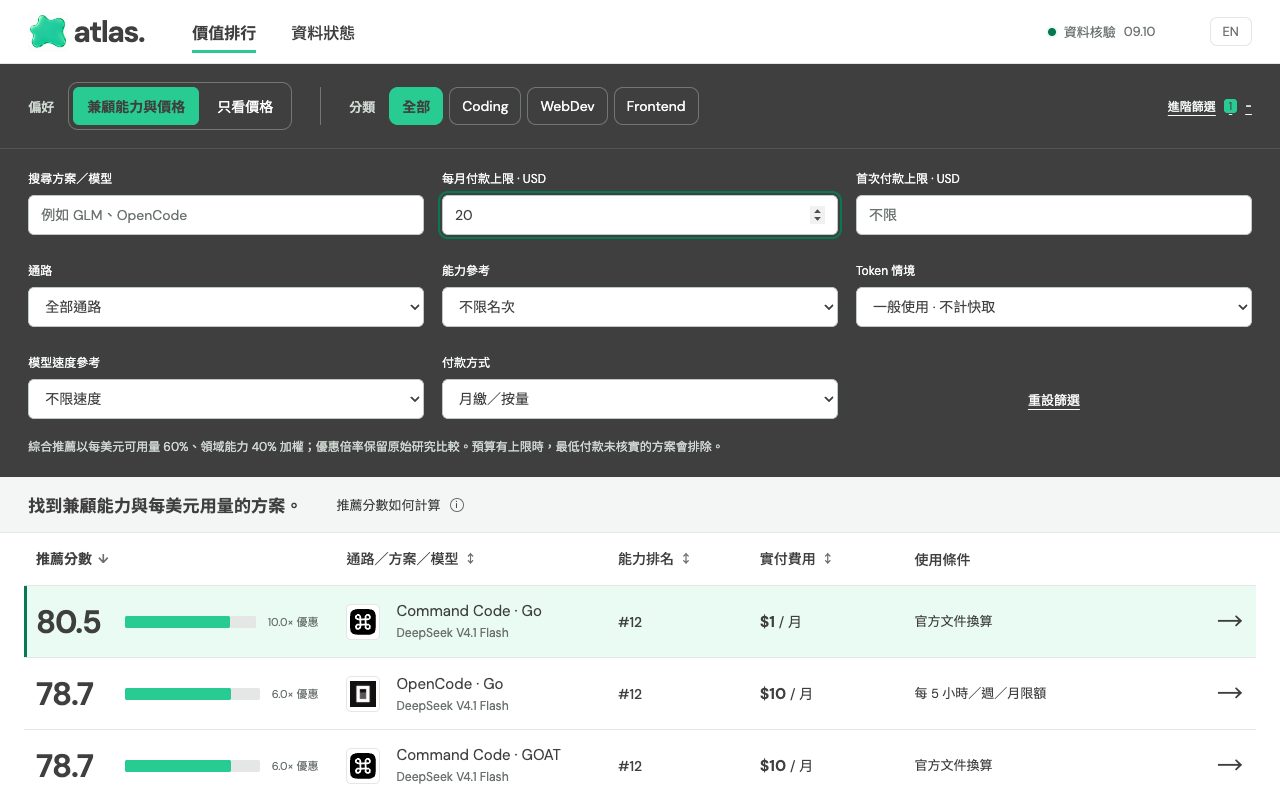
Under $10 a month: Look at Command Code Go / GOAT and OpenCode Go. They package DeepSeek, GLM and similar models into low-cost subscriptions at 6x to 10x. Note that OpenCode Go’s DeepSeek V4.1 Flash currently has an officially labeled limited-time 4x boost; the standard quota is what the documentation table says.
Around $20 a month: For Gemini it’s Google AI Pro, for GPT-6 it’s ChatGPT Plus, both above 20x. If you only need GLM and can avoid peak hours, Z.ai Coding Lite is solid. If you’d rather not commit to a recurring fee, R4 Coder’s one-time prepaid credit valid for 30 days is worth a look.
$100 a month and up: At this tier the question isn’t saving money, it’s whether you can actually use it all. Claude Max 5x and Google AI Ultra 5x both have far higher multipliers than their $20 siblings, but only if your workload fills them. For how quotas reset and how to manage them, see the Claude and Codex usage limits guide.
Too much math? I built a ranking that updates itself
None of the numbers above were computed by hand. They come from a site I built, Atlas, which answers a single question: how much AI does one dollar actually buy?
Main features:
- Two ranking modes: the default “balanced capability and price” sorts by recommendation score; “price only” sorts purely by multiplier, ignoring model strength.
- Four independent boards: All, Coding, WebDev and Frontend, each with its own capability percentiles, so mixed-model estimates are never presented as single-model usage.
- Advanced filters: cap monthly or upfront spend, pick a provider, require a top-N capability rank or a minimum output speed, or search plans and models by name.
- Every row expands into its calculation conditions: the arrow on the right opens a detail view with the usage scenario (how five-hour or weekly windows are amortized), whether the source is an official document or a multi-source estimate, and when the data was last verified.
- A data status page: shows the current data version and last verification date so you can judge freshness yourself.
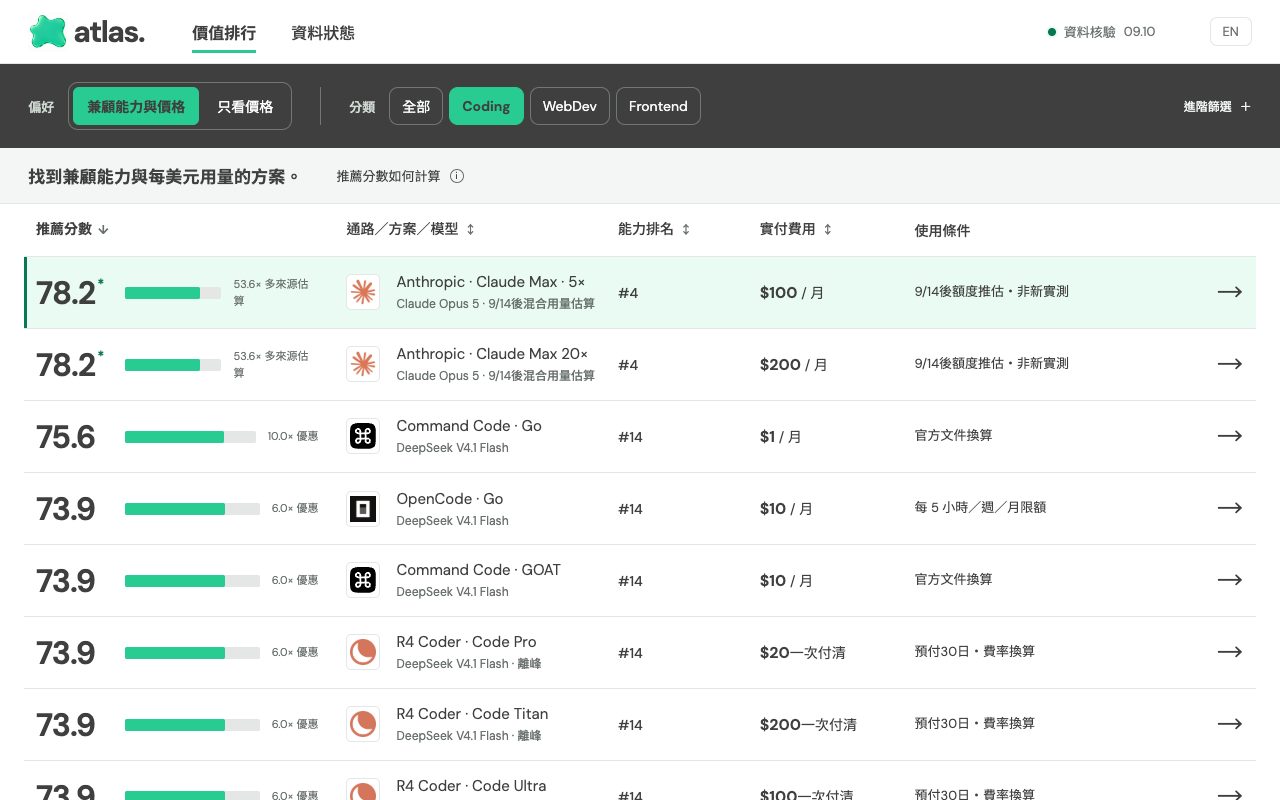
Switch to the Coding board and the capability percentile is recomputed from the Coding Arena leaderboard: Claude Max moves from second to first and Command Code Go drops to third. The same plans rank differently by domain, which is the whole point of separate boards.
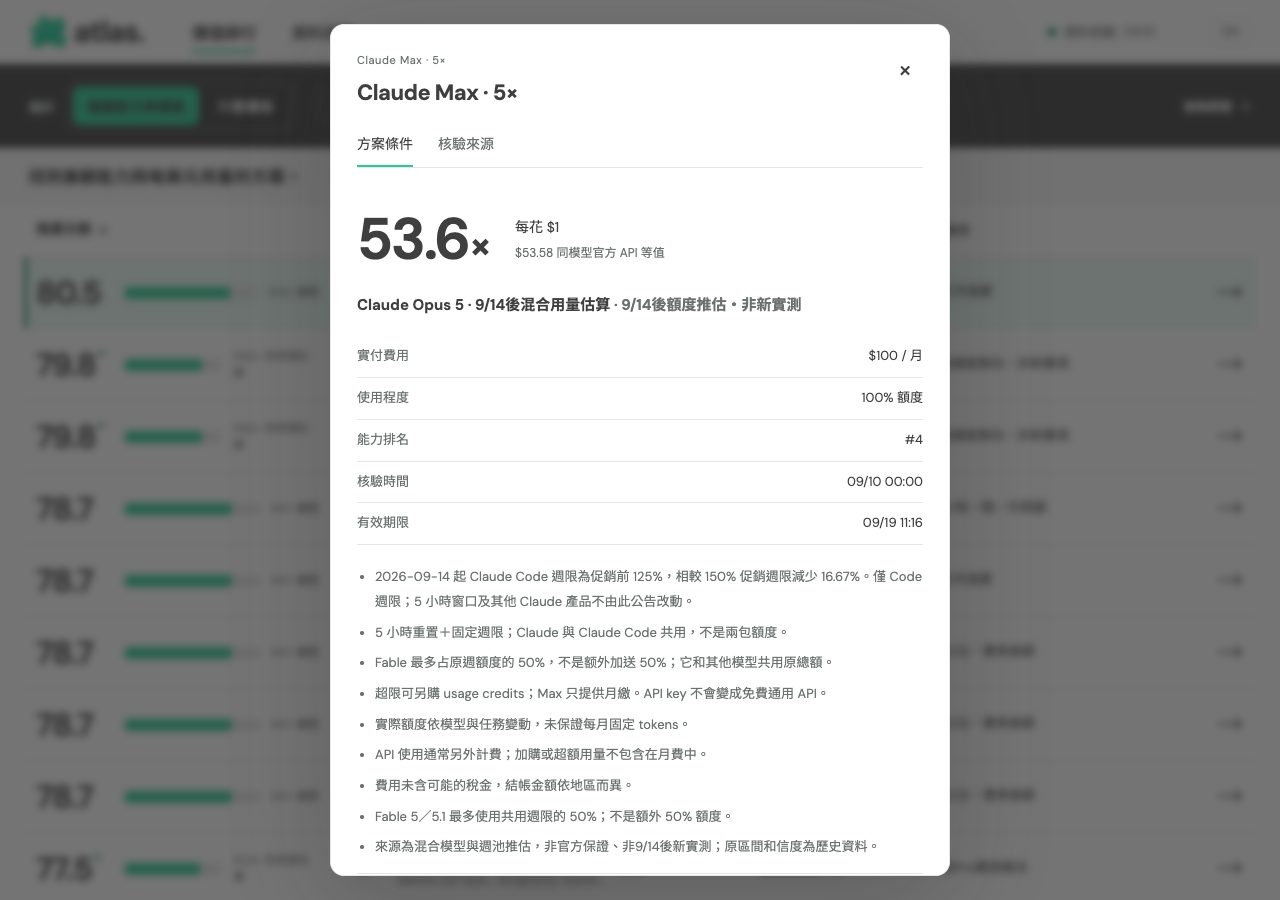
Open the Claude Max 5x details and you can see where 53.6x comes from: the September 14 change of the Claude Code weekly limit from 150% to 125% of the pre-promo baseline, the shared five-hour window and weekly cap, Fable capped at 50% of the weekly quota, and so on, all listed, with an explicit label that this is not an official guarantee or a fresh post-September-14 measurement.
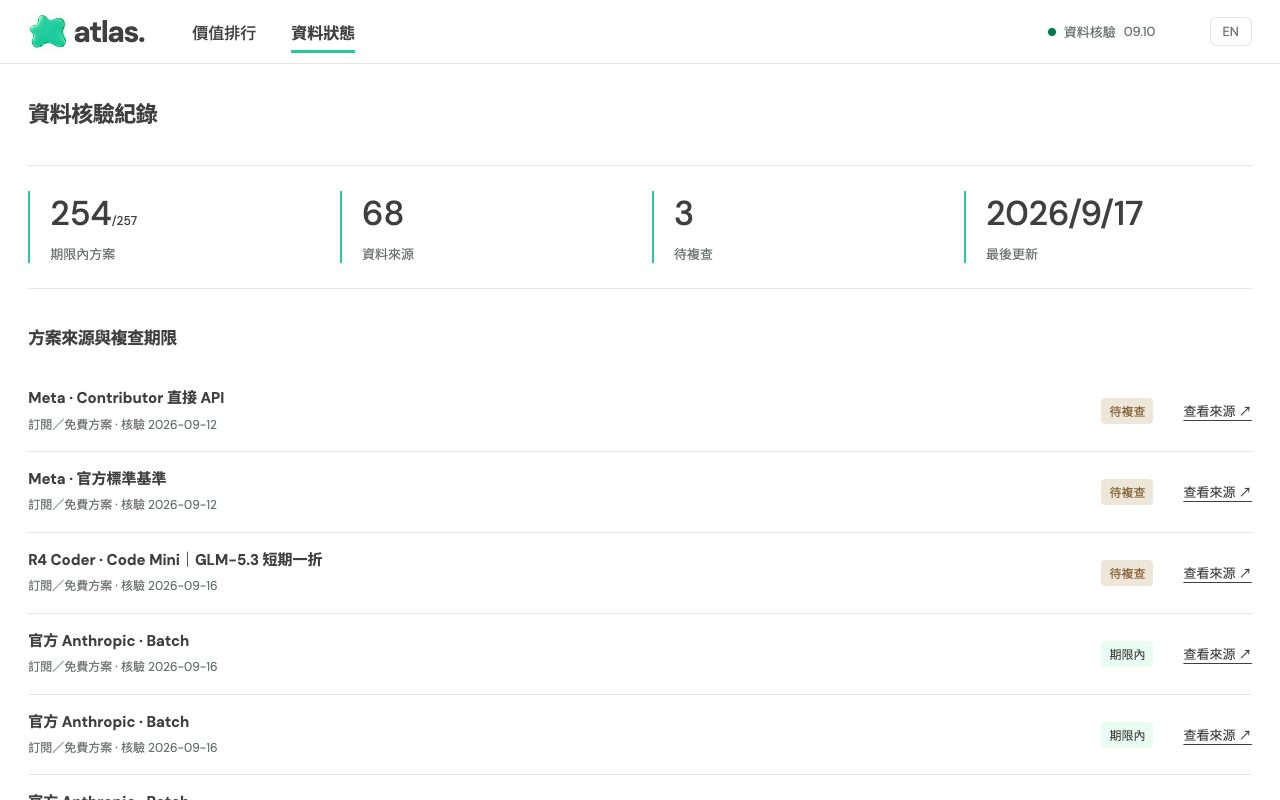
Behind it is a daily update loop: scheduled collection of the latest rates, two-stage AI review of proposed changes, manual locks on important fields, and a quarantine for anomalous data instead of silent overwrites. It currently covers 15 providers and 131 rankable plan-model combinations. The goal is a ranking that reflects today, not the day some article was published.
Three reminders before you buy
API-equivalent is not income, and not a guaranteed quota. It means “what the same usage would roughly cost at official API pricing”. Subscriptions are a bet on utilization: the fuller you use it, the more real the multiplier; use it lightly and the monthly fee is just a monthly fee.
Asterisked numbers are estimates. Multi-source usage research keeps its original weights and confidence ranges. It isn’t thrown away for being unofficial, but it isn’t dressed up as a measurement either. Open the details before you pay.
Off-peak, peak and limited-time boosts all change the multiplier. Z.ai has off-peak pricing, OpenCode has a limited-time 4x, R4 Coder splits peak and off-peak. The same plan can appear in several rows precisely because the conditions differ.
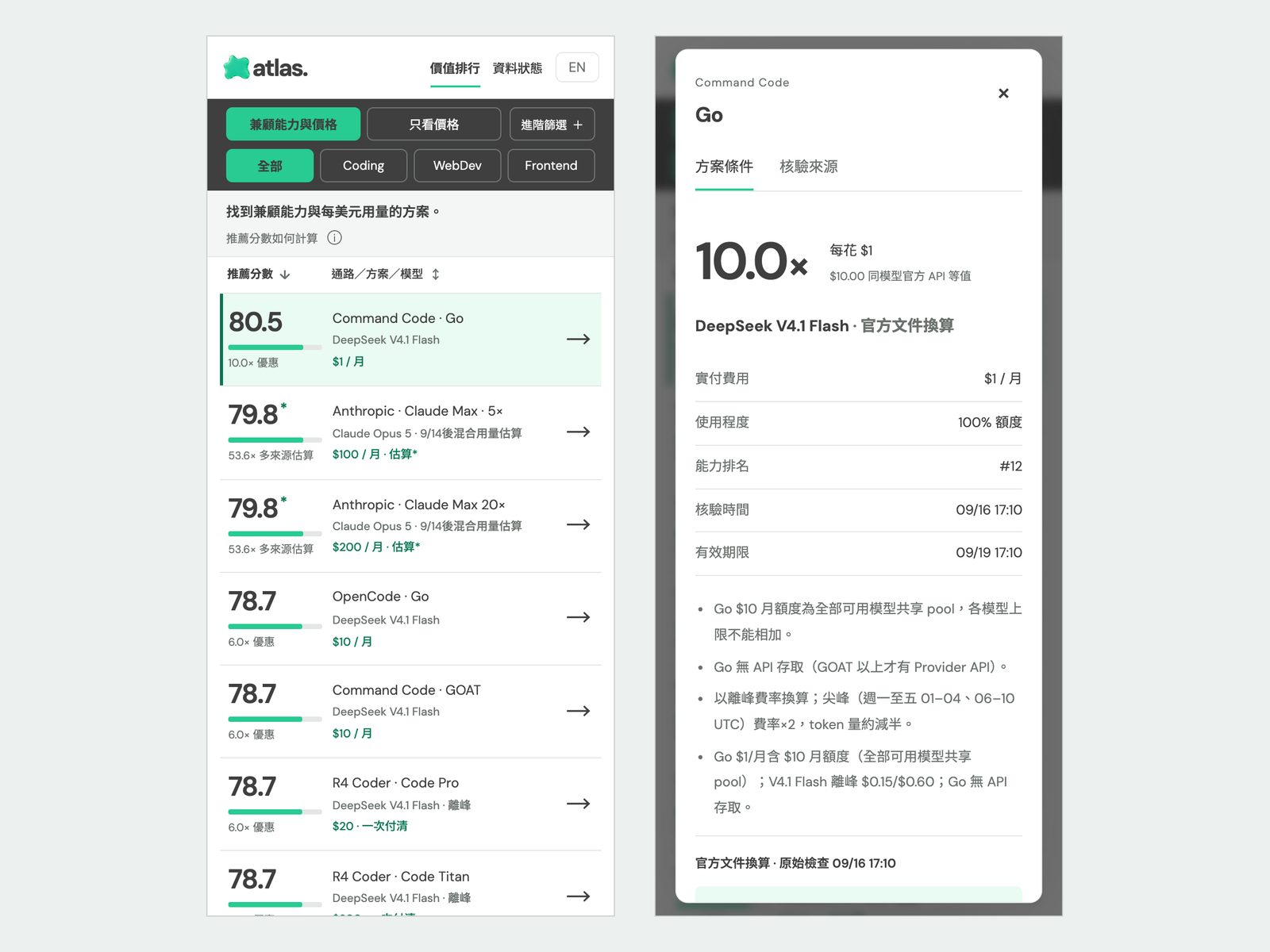
The site is at atlas.6yuwei.com, with a mobile layout that got its own tuning pass. Next time you’re about to put an AI subscription on your card, spend a minute checking how the board has reshuffled, then decide who gets your $20.


